Gone Cold: The Gut-Wrenching Moment Your Cat Ghosted Their Own Favorite Toy
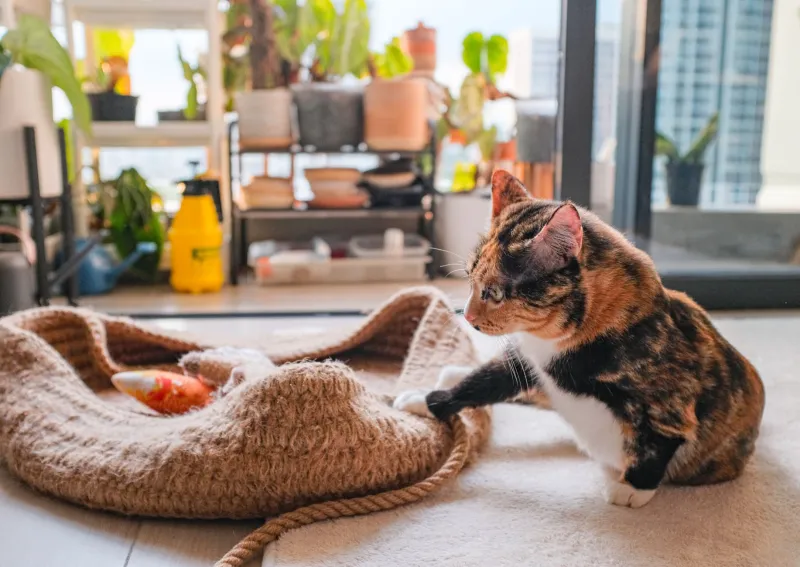
It starts like a great romance. Your cat discovers a toy — maybe it's a feathery wand, a crinkle tunnel, or a humble plastic spring from a multipack you bought at Target for four dollars — and suddenly, they are devoted. We're talking sunrise-to-sunset dedication. You find the toy in the food bowl. You find it in your shoe. You find it at 2 AM because it has been batted directly into your sleeping face.
And then, one Tuesday, nothing.
The toy sits in the middle of the living room floor. Your cat walks past it. Through it, spiritually. Like it doesn't exist. Like it never existed. Like you didn't just spend three weeks narrating their adventures with that little felt mouse to your coworkers on Zoom.
Welcome to the Great Cat Toy Betrayal. Population: every single cat owner in America.
The Obsession Phase: A Brief, Beautiful Lie
Before we get into the abandonment, let's honor the good times. Because the obsession phase is real, and it is genuinely wonderful. Cats in full toy-love mode are a joy to witness. They chirp. They stalk. They execute athletic maneuvers that would make an Olympic gymnast feel inadequate.
Veterinarians and animal behaviorists will tell you this phase is deeply rooted in predatory instinct. Cats are hardwired hunters, and a new toy triggers the same neurological excitement as encountering actual prey. The unpredictable movement, the texture, the sound — it all fires up the hunting sequence: stalk, pounce, catch, kill.
The key word there is kill.
Because here's the uncomfortable truth your cat's therapist would probably surface eventually: once they've "killed" the toy enough times, the prey is dead. The hunt is over. There is nothing left to conquer.
Your cat isn't being fickle. They're being a predator. Congratulations on raising a tiny apex killer who has now moved on to scouting new territory, which is currently your ankles.
The Science of Getting Bored (Explained Rudely)
There's an actual term for what your cat is experiencing: habituation. It's the process by which repeated exposure to the same stimulus produces a diminishing response. In human terms, it's why you stopped tasting your lunch by day four of the same meal prep routine.
For cats, habituation hits fast and hits hard. Studies in feline cognition — yes, this is a real field, yes the researchers are heroes — suggest that cats lose interest in objects significantly faster when those objects don't change. A toy that smells the same, moves the same, and makes the same sound every single time eventually becomes furniture.
This is also why the toy your cat ignored for six months suddenly becomes interesting again after you put it in a bag with some catnip and leave it on a shelf. Absence, novelty, and a little olfactory mystery are apparently the love languages of the domestic cat.
Dr. Mikel Delgado, a certified cat behavior consultant who has spent considerable professional energy trying to understand these creatures, has noted that cats need variability in play. Rotation is key. The toy graveyard under your couch isn't a failure — it's a waiting room.
Owner Testimonials: The Emotional Wreckage
We reached out to a completely informal and unscientific sampling of cat owners (read: we asked around), and the testimonials were, frankly, devastating.
"I spent forty dollars on an interactive robot toy that moved on its own," said one owner from Chicago. "He played with it for eleven days straight. Then he sat next to it, looked me dead in the eyes, and knocked it off the counter. He has not acknowledged it since. That was eight months ago."
Another owner described a three-year love affair between her cat, Margot, and a specific brand of fuzzy mice that has since been discontinued. "I bought them in bulk when I found out they were being discontinued. Margot stopped caring about them the same week the new shipment arrived. I have 47 fuzzy mice in a Ziploc bag in my closet and a cat who now only wants to attack my hair tie."
Perhaps the most tragic account came from a man in Portland whose cat, Gerald, became obsessed with a bottle cap. Just a regular bottle cap from a La Croix. "I saved every La Croix bottle cap for two months. I have a mason jar of them. Gerald now exclusively plays with a twist tie."
The mason jar of bottle caps has become a kind of monument. A memorial to a love that was real, even if it wasn't reciprocated.
Is Your Cat Playing Mind Games? (Short Answer: Maybe)
Here's where things get philosophically murky. Because while habituation and predatory instinct explain a lot, they don't fully account for the specific theatrical quality of cat toy rejection. The pointed look. The deliberate step-over. The way they will sit next to the toy, grooming themselves with aggressive indifference.
Some animal behaviorists suggest that cats are sensitive to owner attention and learn quickly which behaviors generate a response. If you've ever frantically wiggled a toy trying to re-engage your cat, only to be met with a slow blink and a yawn, congratulations — you may have accidentally trained your cat to enjoy your desperation.
This isn't malicious. Probably. But it is worth noting that cats are remarkably good at reading human emotion and have had roughly 10,000 years of living alongside us to figure out which buttons to push.
So yes. Partially science. Partially the ancient, ineffable chaos of being a cat person.
How to Survive the Rejection and Reignite the Spark
Good news: the toy isn't dead. It's just resting. Here's how to stage a comeback:
Rotate, don't replace. Put toys away for two to three weeks, then reintroduce them. The "new" smell and context can reset your cat's interest almost entirely. It's the toy equivalent of a surprise return.
Add scent. A light dusting of catnip or a spritz of silver vine spray can transform a boring old toy into an object of renewed fascination. Think of it as giving the toy a personality upgrade.
Change how you play. If you've been dragging the wand in the same figure-eight pattern for six months, your cat has clocked your technique. Try erratic movements, hiding the toy under a blanket, or letting it "escape" around a corner. Mimic real prey behavior.
Accept the twist tie. Sometimes the universe is telling you something. That something is: your cat is a chaos agent and you will never fully understand them, and that's kind of the whole point.
The Takeaway (If Cats Allowed Such Things)
The Great Toy Betrayal is not a referendum on your relationship with your cat. It is not a sign that you chose wrong at PetSmart. It is simply the nature of the beast — literally.
Your cat loved that toy with their whole tiny predatory heart. They stalked it. They murdered it. They moved on. That's not abandonment. That's mastery.
And somewhere in your closet, in a Ziploc bag or a mason jar or a sad little pile under the couch, the toy waits. Patient. Hopeful. Ready for its second act.
Just like Gerald's bottle caps.