The 47-Minute Audition: Decoding Your Cat's Agonizingly Slow Approval Process
You adopted a cat. You went home, set up the food bowl with genuine tenderness, placed the little bed in a cozy corner, and waited. You were ready to be loved. You had so much love to give.
Your cat walked out of the carrier, looked directly at you, and retreated behind the washing machine for six hours.
Congratulations. The audition has begun.
Unlike dogs, who will emotionally adopt you within approximately forty-five seconds of eye contact, cats operate on a timeline that is entirely their own — one that seems to have been designed by a committee of very suspicious middle managers who've been burned before. If you've ever watched your cat inch toward you over the course of what felt like a geological era, only to finally press their forehead against your shin like it was their idea all along, you already understand the process. You just don't understand why.
Let's fix that.
Phase One: The Threat Assessment (Minutes 0–12)
This is the phase where your cat has technically entered the room but refuses to acknowledge that you exist. They're not ignoring you — that implies a relationship. They're simply gathering data. You are an unclassified object. A large, weirdly warm obstacle that keeps making soft noises and reaching toward them with an open hand like some kind of enormous, hairless bear.
During this phase, your cat is running a full background check. They're cataloging your smell, your posture, the specific frequency of your voice, and — crucially — whether you seem like the kind of person who makes sudden movements. Any sudden movements at this stage will reset the clock entirely. You will go back to square one. The committee has adjourned.
The correct response to Phase One is to do absolutely nothing. Sit on the floor if you can manage it, because height is power and you need to relinquish every advantage you have. Read a book. Look mildly bored. You are not auditioning. You are simply existing, and your cat will find this deeply suspicious but ultimately more tolerable than enthusiasm.
Phase Two: The Proximity Experiment (Minutes 13–28)
Something has shifted. Your cat is now approximately three feet closer than they were before, and you didn't see them move. This is intentional. They have engineered this approach so that you cannot pinpoint the exact moment trust began, because that information is proprietary.
They may sit and stare at you during this phase with the focused intensity of a federal auditor. This is normal. What they're actually doing is stress-testing your reaction to being watched. Do you lunge? Do you squeal? Do you grab your phone and start filming? All of these are disqualifying behaviors. The correct response is to glance at them briefly, perhaps blink slowly once, and then look away like you have somewhere more important to be.
The slow blink, for the uninitiated, is the feline equivalent of a polite handshake. It communicates, roughly: I see you. I don't currently consider you a threat. Let's not make this weird. If your cat slow-blinks back, you have just passed the preliminary round. Try not to celebrate visibly.
Phase Three: The Controlled Approach (Minutes 29–41)
This is the most emotionally precarious phase, because you can see it happening. Your cat is walking toward you. Slowly. Deliberately. With the measured confidence of someone who has decided to grace you with their presence and wants to make sure you understand the magnitude of that decision.
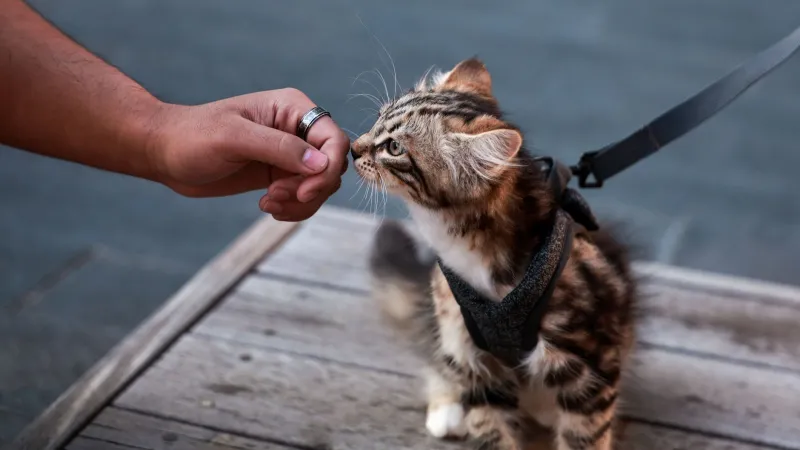
They will stop approximately eight inches away from your outstretched hand and sit down. They will look at your hand. They will look at your face. They will look at your hand again. Then they will look slightly to the left of your hand, as if considering a third option that doesn't involve commitment.
Do not move your hand. Do not wiggle your fingers. You are not luring a fish. You are waiting to be chosen, and there is a meaningful difference.
At some point during this phase, your cat may sniff the tips of your fingers with a level of forensic thoroughness that borders on the medical. This is the final background check. They are confirming everything they suspected about you, cross-referencing it against their internal database of acceptable humans, and making a preliminary ruling.
Phase Four: The Verdict (Minute 42–47)
It happens without fanfare. One moment your cat is a sovereign entity conducting an independent review of your worthiness. The next, they have pressed the top of their head against your hand and are rubbing their face along your knuckles with the casual ownership of someone who has always lived here and simply allowed you to tag along.
This is called bunting, and it means your cat has just marked you as theirs. Not in a romantic way — more in the way that a middle manager stamps a file approved and slides it into a cabinet without making eye contact. You have been processed. You are now an official part of the territory.
The whole thing took 47 minutes. It felt like much longer.
What the Speed of Warming Actually Tells You
Here's the part nobody talks about: the timeline itself is meaningful data.
A cat who warms up in under twenty minutes is either unusually social, has had consistently positive experiences with humans, or is, frankly, a little too trusting and should probably develop better judgment. A cat who takes several days — or weeks — to fully accept you isn't broken or traumatized by default. They may simply have higher standards. They've been disappointed before. They are not giving away trust on a promotional basis.
And a cat who takes the full 47-minute theatrical production, complete with staring, strategic retreats, and the forensic finger-sniff? That cat is performing due diligence. When they finally decide you're worth the head-press, they mean it in a way that a cat who flopped over for belly rubs on day one simply cannot.
The slowness is not rejection. The slowness is the process. And the process, maddening as it is, is exactly what makes the approval feel like something worth having.
The Uncomfortable Truth
Your cat does not owe you affection on your timeline. They never did. The entire framework of cat ownership — if we can even call it that without laughing — is built on the understanding that you provide the resources and they provide the company, on terms they negotiate unilaterally and revise without notice.
The 47-minute audition is not a problem to solve. It's a feature of the relationship. It's your cat saying, in the only language they have: I don't hand this out to just anyone. But I'm considering making an exception for you.
And honestly? After all that? You'd better not blow it by sneezing too loud.