Bowl Adjacent: The Calculated Audacity of a Cat Who Has Decided Your Other Cat's Dinner Is Simply Better
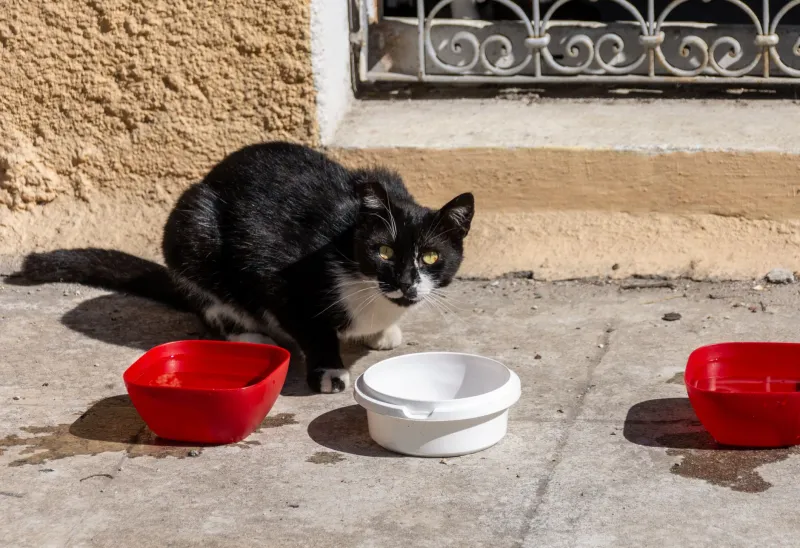
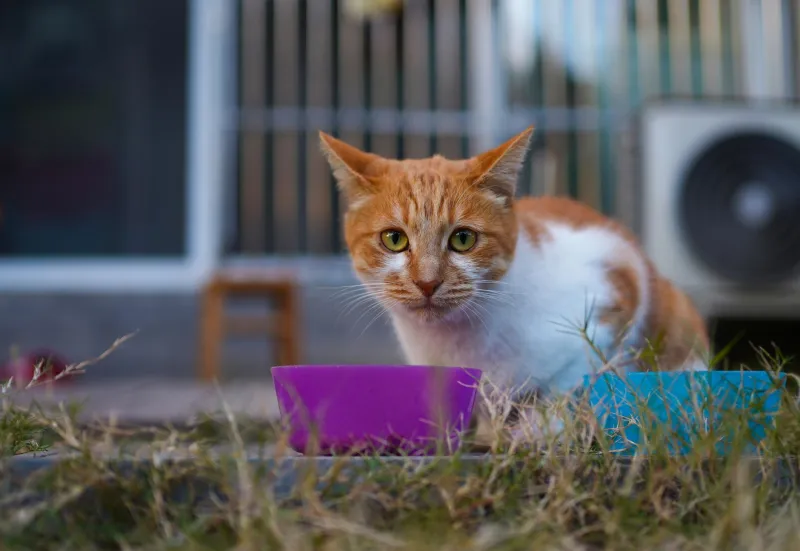
Let's set the scene. You've just placed two identical ceramic bowls on the kitchen floor, each containing the exact same amount of the exact same food — down to the gram, because you've been driven to that level of precision by repeated household conflict. You step back. You feel like a reasonable person. And then, in the span of approximately four seconds, Mochi has abandoned her own bowl entirely and is now shoulder-deep in Gerald's dinner while Gerald stares at you with the hollow eyes of a creature who has witnessed injustice and no longer believes in institutions.
This is Tuesday. This is every Tuesday.
The Great Kibble Heist is not an accident. It is not confusion. It is a deliberate, sustained, multi-phase operation executed by an animal who has assessed the situation, identified an opportunity, and concluded that their sibling's bowl represents something fundamentally more valuable than their own — despite all available evidence to the contrary.
Welcome to the multi-cat household food economy. Population: you, two cats, and a growing sense that you are not in charge of anything.
The Identical Bowl Problem, or: Why Sameness Means Nothing to a Cat
Human logic suggests that if two bowls contain the same food, the bowls are interchangeable. Cat logic suggests that the bowl currently occupied by another cat contains a rare and precious resource that must be acquired at any cost.
This is not a nutrition issue. Veterinarians will tell you, politely, that the food is the same. The calories are the same. The protein content is the same. The little fish-shaped kibble pieces are distributed in roughly equivalent quantities across both vessels. None of this matters to Mochi. What matters to Mochi is that Gerald is eating, and wherever Gerald is eating is, by definition, the superior location.
Researchers — and by researchers, we mean exhausted cat owners posting in Reddit threads at midnight — have documented this phenomenon extensively. The consensus is grim: cats do not want their food. They want the other cat's food. The food they have is merely a placeholder, a decoy bowl they maintain no emotional attachment to whatsoever.
The Psychological Warfare Phase
Before the actual theft occurs, there is almost always a reconnaissance period that cat behaviorists would probably find fascinating if they were watching it happen to someone else's household.
Mochi will finish approximately 40% of her own meal. Then she will sit down next to her bowl, not eating, simply existing — but with her eyes fixed on Gerald's bowl in a way that communicates volumes. Gerald, sensing the attention, will eat faster. This is a mistake. Eating faster signals to Mochi that the bowl contains something worth rushing for, which only intensifies her interest.
At some point, Mochi will begin the slow, deliberate walk. Not toward Gerald directly. That would be too obvious. She'll arc around the perimeter of the kitchen, pausing to sniff the baseboard, pretending to be interested in absolutely nothing in particular. Gerald watches. You watch. Everyone knows what's happening. Nobody can stop it.
Then, with the confidence of someone who has done nothing wrong and will never accept that they have done anything wrong, Mochi simply inserts her face into Gerald's bowl.
Gerald looks at you. You look at Gerald. The moment hangs there, thick with the specific helplessness of a person who has tried everything and has run out of ideas.
The Justifications Your Cat Would Offer, If Asked
Cats do not explain themselves. But if Mochi could speak — and frankly, based on the eye contact she maintains during these incidents, she has a lot to say — her reasoning would likely fall into one of several categories.
The Freshness Argument. Gerald's bowl was served three seconds after mine. His food is therefore newer. Newer food is better food. This is science.
The Location Argument. Gerald's bowl is approximately eight inches to the left of mine. That is the better eight inches. I should be eating there.
The Scarcity Principle. Gerald is eating his food, which means it is clearly desirable and therefore limited. I must secure my portion of this desirable limited resource before it is gone. The fact that my identical bowl is full and unthreatened is irrelevant.
The Territorial Expansion Model. This isn't really about food. This is about establishing that all bowls, in all locations, are within my operational jurisdiction. Gerald's bowl is simply the most recent acquisition in an ongoing portfolio.
Any of these explanations would be maddening. All of them are somehow correct.
Multi-Cat Feeding Solutions, Ranked by How Long They Actually Work
If you have spent any time in multi-cat owner forums — and if you have two cats and a problem, you have definitely spent time in multi-cat owner forums — you have encountered the full spectrum of attempted solutions. Here is an honest assessment.
Separate rooms: Works perfectly, until one cat learns to open doors or you feel too guilty to maintain the policy through the plaintive yowling.
Supervised feeding: Requires you to stand in the kitchen for the duration of every meal, which is technically possible but will make you feel like a crossing guard for cats, which is not a dignity most people can sustain long-term.
Elevated bowls for one cat: Briefly effective. The other cat will learn to jump within forty-eight hours.
Puzzle feeders: Slows down the faster eater, which is genuinely useful, until the faster eater solves the puzzle immediately and then goes and solves the other cat's puzzle too.
Buying a second identical puzzle feeder: Currently the reigning champion solution in many households, with an average effectiveness window of about three weeks before the situation evolves.
The honest truth is that the multi-cat food economy is a living system, and it adapts. Every solution creates a new equilibrium, and every new equilibrium eventually gets disrupted by a cat who has had enough time to think about it.
Gerald Deserves Better, and He Knows It
In every multi-cat household running this particular operation, there is a Gerald. Maybe your Gerald is named Beans, or Theo, or Sir Fluffington the Reluctant. The name doesn't matter. What matters is that Gerald is standing next to an empty bowl that used to be his dinner, looking at you with an expression that communicates, with devastating clarity, that he expected more from this arrangement.
Gerald is not wrong. Gerald signed up for a bowl of food, not a geopolitical negotiation over shared resources. Gerald did not read the fine print on multi-cat household living, and honestly, neither did you.
But here's the thing about Gerald, and about every cat in his position: he will be back at that bowl tomorrow. And so will Mochi. And you will place the same two identical bowls on the same kitchen floor and watch the same ancient drama play out with the resigned acceptance of someone who has made peace with their situation.
Because at the end of the day, Mochi isn't stealing Gerald's food because she's cruel. She's stealing it because it's there, because he has it, and because the entire concept of 'mine' versus 'yours' is a human framework that she finds deeply unpersuasive.
She has a career to maintain, after all. And business is good.