Eyes Half-Shut and Fully in Charge: The Slow Blink Cult Your Cat Has Recruited You Into
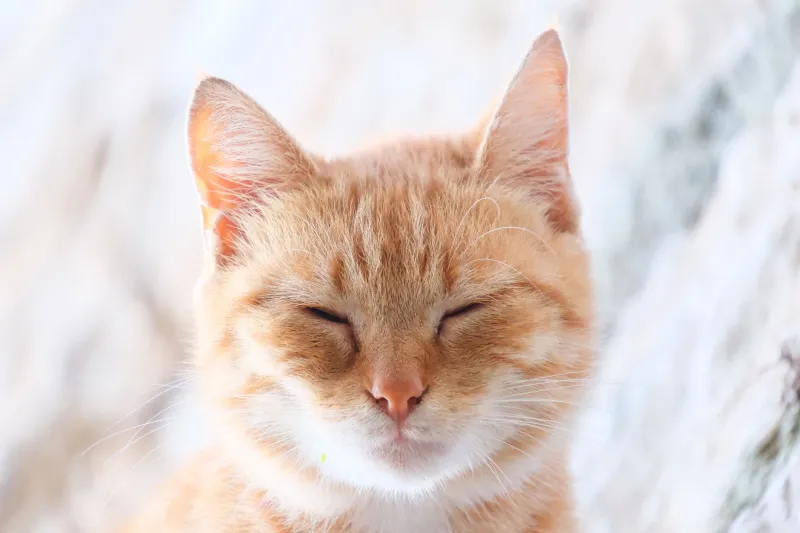
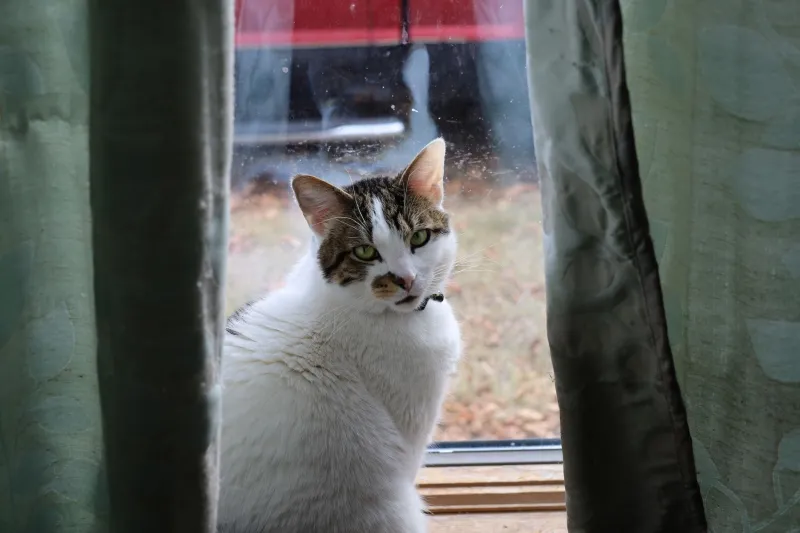
It started innocently enough. You were sitting on the couch, minding your own business, when your cat — let's call him Gerald — looked at you from across the room with those half-lidded, ancient, inscrutable eyes and blinked. Slowly. Deliberately. Like a tiny furry Buddha delivering a message from another dimension.
You Googled it immediately. Of course you did.
And the internet, in its infinite wisdom, told you that the slow blink is the feline love language. A cat kiss. A silent "I trust you, weird tall creature who controls the food." You felt something shift in your chest. A warmth. A validation. Gerald loved you. Gerald was communicating.
That was six months ago. Now you slow-blink at Gerald approximately forty times a day, you've started tracking his responses in a notes app, and you recently cancelled dinner plans because you were "in the middle of a moment" with him. You are, by every clinical definition, in a cult. Gerald is the leader.
What the Science Actually Says (And How You'll Misuse It)
Here's the thing: the slow blink is real. Researchers at the University of Sussex published a study in 2020 confirming that cats are more likely to slow-blink back at humans who slow-blink at them first, and that they tend to approach people who use the gesture. The study even suggested it as a practical tool for building rapport with unfamiliar cats — which is genuinely useful if you're, say, a shelter volunteer or someone who needs a feral cat to stop treating you like a personal threat.
What the study did not confirm is that your cat Gerald is deeply in love with you, has forgiven you for the vet visit, or is trying to tell you something specific about your life choices. Those are projections. Beautiful, human, completely understandable projections — but projections nonetheless.
The slow blink, at its scientific core, signals non-aggression. It's the feline equivalent of saying "I'm not about to attack you right now." Which, yes, in cat terms, is basically a declaration of affection. But there's a meaningful gap between "I have decided not to claw your face" and "you are my soulmate and I understand you completely." A gap that cat owners, bless us, sprint across without looking down.
The Paranoia Pipeline
Once you learn about the slow blink, you cannot unlearn it. Every interaction with your cat becomes a potential data point. Did she blink slowly when you walked in? That's love. Did she not blink when you came home? Something is wrong. Did she blink but then immediately look away? She's hiding something. Did she blink and then knock your water glass off the counter? She's testing you.
This is the paranoia pipeline in action, and it runs on a fuel mixture of genuine affection for your animal and a very human need to feel understood by something that cannot speak. Cats, who have spent approximately 10,000 years exploiting exactly this need, are perfectly positioned to keep the pipeline flowing.
The real psychological trap isn't that you're reading the slow blink wrong. It's that you're never sure if you're reading it right, and that uncertainty is more addictive than certainty would ever be. If Gerald slow-blinked and you knew for a fact what it meant, you'd move on. But because you'll never fully know — because Gerald maintains plausible deniability at all times — you keep watching. You keep analyzing. You keep sending follow-up blinks like unanswered texts.
Gerald, meanwhile, may genuinely just be sleepy.
Confessions From the Blinking Faithful
You are not alone in this. Not even close. Across the country, otherwise rational adults are hunched toward their cats with their eyes going soft and slow, whispering "did you see that? Did you see what he did back?"
There are people who've rearranged their living room furniture to create better slow-blink sightlines. People who've interrupted work calls to blink at their cat from across the room, muted and squinting at their laptop camera like they're trying to communicate through a submarine periscope. People who've reported — with complete sincerity — that their cat's slow blink "felt different" on a Thursday, and they're still not sure what it meant.
One woman in Ohio reportedly slow-blinked at her cat for fifteen straight minutes before realizing the cat was asleep with its eyes partially open. She described the experience as "emotionally complex." She has not stopped slow-blinking.
This is what Gerald has done to us. This is what they've all done to us.
The Fine Line Between Connection and Delusion
Here's where it gets genuinely interesting, though — and where Albert Cat is willing to go on record with a take: maybe the line between real connection and cheerful delusion doesn't matter as much as we think.
Human-animal bonds are real. The comfort cats provide is real. The neurological hit of mutual eye contact with a creature you love is real, regardless of whether that creature is processing it the same way you are. If slow-blinking at your cat makes you feel closer to them, and they seem relaxed and comfortable in your presence, something meaningful is happening — even if it's not the telepathic soul-merger you've convinced yourself it is.
The slow blink works because it's a genuine act of vulnerability. You're making yourself soft-eyed and non-threatening. You're signaling calm. Cats, who are exquisitely tuned to threat assessment, notice that. They respond to it. The fact that you've also started narrating the exchange internally as a romance novel subplot doesn't cancel out the real thing happening underneath.
Just maybe dial back the spreadsheet.
Gerald's Official Statement
Gerald was asked to comment for this article. He slow-blinked once, sneezed, and then fell asleep on a tax document you needed. Experts are divided on what this means. The investigation continues.
If you're new to the slow blink and want to try it, the technique is simple: make soft eye contact with your cat, then slowly close and open your eyes. Don't stare intensely before or after — that's a threat display, not a love letter. Be relaxed. Be patient. If your cat blinks back, feel good about it. If they don't, they're probably just busy being a cat, which is a full-time occupation with very little room for your emotional needs.
Either way, you're going to do it again tomorrow. We all do.
Welcome to the cult, friend. Gerald is pleased to have you.