Sixty Dollars of Cardboard vs. Four Hundred Dollars of Cat Tree: A Tragedy in Three Acts
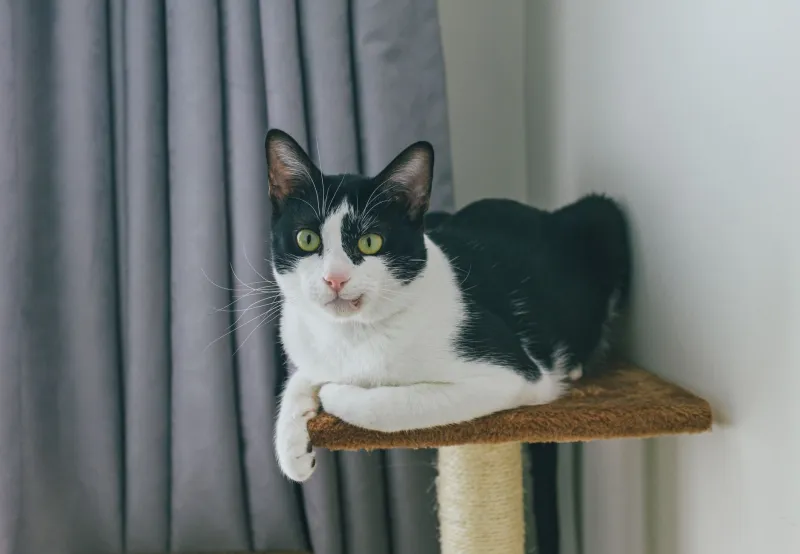
There is a specific kind of grief that has no name in the English language. It's the grief you feel standing in your living room, staring at a six-foot, multi-platform, sisal-wrapped, fleece-lined cat tree — the one that took you ninety minutes to assemble and cost more than your last car payment — while your cat methodically destroys the armrest of a couch you've been paying off since 2021.
This is not a hypothetical. This is Tuesday.
And if you're reading this through the particular fog of someone who has lost this battle recently, welcome. Pull up a chair. The cat is not sitting in it anyway.
The $400 Question Nobody Wants to Answer
Let's establish the stakes. According to the American Pet Products Association, Americans spend billions annually on pet products, and a substantial chunk of that goes toward scratching posts, cat trees, and what the industry optimistically calls "enrichment furniture." These products are engineered by people who presumably own cats, tested by cats who are presumably compensated in treats, and reviewed online by thousands of cat owners who swear their cat loves it.
Your cat has reviewed none of this research and does not care.
The average premium cat tree — the kind with the little condo at the bottom, the dangling toy your cat will bat twice before ignoring forever, and the top platform your cat will never reach because it looks "too stable" — runs anywhere from $150 to $400. The average cat's interest in said tree lasts approximately as long as the box it came in, which, as we have previously documented on this very website, will be occupied for six to eight months.
Meanwhile, the couch suffers.
What Cats Actually Want (According to People Who Study This Professionally)
Here's where it gets interesting — and by interesting, I mean maddening. Cat behaviorists have actual answers for this, and those answers are deeply unsatisfying to everyone who just dropped two hundred bucks at Chewy.
The core issue is texture and resistance. Cats scratch for several reasons: to shed dead nail sheaths, to stretch their shoulder and back muscles, and to deposit scent from glands in their paws. That last part is the kicker. Scratching is territorial communication, and your cat isn't just scratching — they're posting. Like a very physical, destructive version of a social media update that says "I live here and this is mine."
Your couch, it turns out, is prime real estate for this message. It's in a high-traffic area. It smells like you. It has structural integrity that provides satisfying resistance. It does not wobble.
That last point is doing a lot of heavy lifting. Many budget and even mid-range cat trees have a fatal flaw: they move when pushed. Cats do not want a scratching surface that moves. Cats want to scratch something that fights back a little, something that communicates solidity and permanence. Your couch does not wobble. Your couch has been there for years. Your couch has authority.
Your cat tree, assembled by you on a Sunday afternoon while watching football, wobbles at the base when a cat heavier than four pounds engages with it. Your cat clocked this in approximately eleven seconds and has written it off entirely.
A Satirical Field Guide to Reverse-Engineering Your Cat's Standards
Since we cannot interview your specific cat (they are not returning our calls), we've assembled a working theory of the criteria your cat is silently applying to every surface in your home.
Criterion One: Is it yours? The more emotionally attached you are to an object, the higher its appeal as a scratching surface. This is not a coincidence. Cats are not being spiteful — they're being thorough. Your scent on an object makes it a communication hub worth posting on. The cat tree smells like a warehouse in New Jersey and the inside of a cardboard box. Your couch smells like you, and your cat has opinions about that.
Criterion Two: Does it have corners? Flat sisal panels are fine. Corners are a delicacy. There is something about a ninety-degree angle that speaks to the feline soul in a way that no flat surface can replicate. This is why every couch in America has at least one destroyed corner and why cat tree designers continue, bafflingly, to make mostly flat surfaces.
Criterion Three: Will the human react? I'm not saying your cat is performing for an audience. I'm saying your cat is absolutely performing for an audience. The moment you look up from your laptop and say "HEY" in that particular tone, the scratching becomes 40% more vigorous. Engagement is engagement.
Criterion Four: Has it been there long enough to seem permanent? Cats are suspicious of new things. Your brand-new cat tree, placed optimistically in the corner of the living room, is a stranger. Your couch has been in the same spot since the Obama administration. It is a known quantity. It has earned trust. Your cat tree has not.
The Uncomfortable Truth at the Bottom of This
Here is the part where I have to be honest with you, reader, in the way that only a website named after a cat can be.
Some cats just have bad taste.
Not in a cruel way. In the way that some people prefer gas station sushi to a perfectly good restaurant. The preference is real. The reasoning is opaque. The outcome is the same: your nice thing goes unused and the questionable alternative gets all the attention.
You can optimize. You can buy the heavier base, the rougher sisal, the taller post. You can place it next to the couch, rub catnip into the fibers, praise enthusiastically when your cat so much as looks at it. These strategies work, sometimes, partially, for some cats.
Or your cat looks at you — really looks at you — and then turns around and scratches the couch with the focused energy of someone making a point.
The Pragmatist's Ending
If you're looking for a resolution here, the practical advice is well-documented: stable base, vertical and horizontal options, placement near existing scratch sites, positive reinforcement. Cover the couch corners with double-sided tape while you transition. Be patient. Be consistent.
If you're looking for vindication, here it is: you are not bad at owning a cat. You are not failing. You bought the thing. You tried. The cat has simply conducted an independent audit of your home and issued its findings, and those findings are that the couch is superior infrastructure and the cat tree can wait.
Albert Cat regrets to inform you that the audit is ongoing, the couch is losing, and your cat has already moved on to evaluating the dining room chairs.
Good luck out there.