Locked In: The Unsettling Truth About Your Cat's Unblinking Stare (And Why You Should Be Worried)
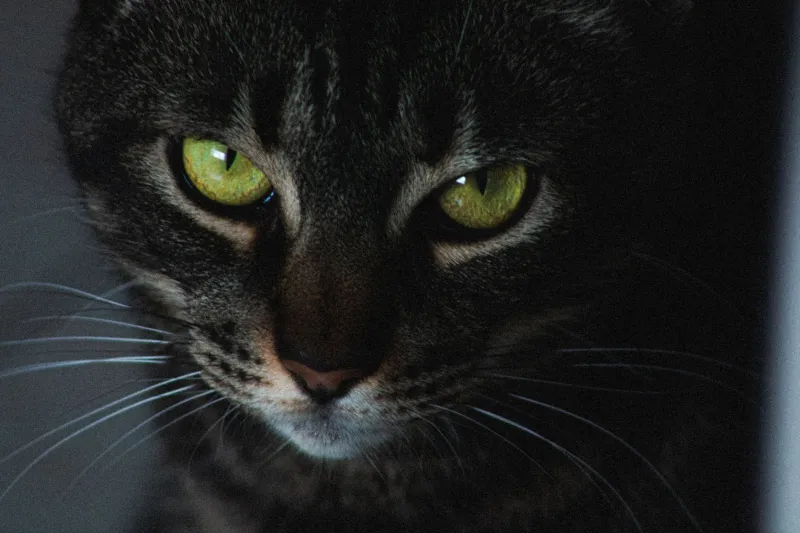
It started innocently enough. You were eating cereal. Your cat, Rutherford — named after a president you vaguely respect — was sitting approximately three feet away on the kitchen counter he is absolutely not allowed on. Your eyes met. Fine. Normal. A brief acknowledgment between two beings who share a lease.
That was eleven minutes ago.
Rutherford has not blinked. You have blinked so many times your eyes are basically doing cardio. The cereal is soggy. The milk is warm. And somewhere in the glossy, inscrutable depths of Rutherford's amber gaze, a plan is being finalized.
Welcome to the Slow Stare Standoff — the most psychologically destabilizing event available to American pet owners that doesn't involve a government agency.
The Mechanics of a Stare That Could Unnerve a Parking Enforcement Officer
Here's what the science people will tell you: cats use prolonged eye contact as a dominance signal. In feline social dynamics, looking away first is a form of submission. It's a primal acknowledgment that the starer holds the power, the territory, and presumably the better spot near the heating vent.
Here's what the science people won't tell you: your cat has been practicing this on you specifically, studying your particular brand of psychological fragility, and calibrating the intensity of the stare to land somewhere between mildly unsettling and I need to call someone about this.
Rutherford isn't just making eye contact. He's conducting an audit.
A Brief History of Who Started It (Spoiler: You Did)
You made the first mistake years ago, probably during that week you decided to "bond" with your new cat by reading an article that said sustained eye contact builds trust. You stared into his eyes with the open, earnest energy of someone who just discovered mindfulness. You meant it lovingly.
Rutherford filed that information away like a dossier.
Every subsequent stare has been a callback to that original moment of vulnerability. He knows you'll look away. He knows it'll happen around the thirty-second mark, when the social discomfort becomes too much and you suddenly find the refrigerator absolutely fascinating. He has timed you. He has data.
You are a known quantity, and that is genuinely the most humbling thing a twelve-pound animal has ever done to a grown adult.
What Is Actually Happening Behind Those Eyes
Let's be generous and explore the innocent explanations first.
Possibility one: your cat is simply tracking movement. Cats are hardwired predators, and their visual systems are finely tuned to detect the slightest twitch. When Rutherford stares at you while you eat cereal, he may simply be monitoring the spoon's trajectory with the focus of a minor league outfielder.
Possibility two: he's waiting for something. Food. Affection. For you to move so he can take your warm seat. These are all legitimate cat motivations, and the stare is merely his most efficient communication tool, since meowing at full volume at 6 AM apparently wasn't getting results fast enough.
Possibility three — and this is the one we at Albert Cat believe deserves the most serious consideration — he is running scenarios. The stare is the loading screen. Behind it, a complex feline operating system is processing variables: the location of the good throw blanket, the structural integrity of the blinds, the precise moment you'll leave for work and the apartment will revert to its rightful owner.
The stare is not a stare. It's a strategy session you weren't invited to.
The Moment He Finally Looks Away (Do Not Relax)
Here's where it gets interesting. Here's where you need to pay attention.
When your cat breaks the stare — and he will, eventually, on his own terms and timeline — the amateur observer might interpret this as a concession. He looked away. I win. We're good.
You sweet, naive person.
The look-away is not surrender. The look-away is the conclusion of the planning phase. Whatever Rutherford was plotting during those eleven minutes of unbroken ocular intensity, the decision has been made. The stare ends because the thinking is done. He doesn't need to look at you anymore. He knows what he's going to do.
What is he going to do? Statistically, based on observed cat behavior across thousands of American households, the answer falls into one of three categories:
- He is about to knock something off a surface with a deliberateness that borders on performance art.
- He has decided, effective immediately, that the specific corner of your couch where the armrest meets the cushion needs to be aggressively reconsidered — with his claws.
- He's going to walk into another room, do something you'll discover later, and be completely asleep by the time you find it.
All three outcomes share a common thread: you will be involved, and you will not enjoy it.
How to Conduct Yourself During a Standoff (You Won't Follow This Advice)
The recommended approach, according to actual cat behaviorists, is to offer a slow blink — the so-called "cat kiss" that signals non-threatening intent. It's a way of communicating that you come in peace, that you acknowledge the feline social contract, that you are not a threat.
This is excellent advice that you will absolutely not execute correctly because the moment you try to slow-blink at Rutherford, you'll blink too fast, or too slow, or you'll squint in a way that reads as aggression, and now you've made it worse. He'll stare harder. You'll panic-blink. The whole thing will spiral.
Alternatively, you could just look away first. Accept the outcome. Acknowledge that in the great hierarchy of your shared living situation, you are the one who pays the rent and he is the one who actually owns the place, and these are simply different but equally valid roles.
Some people find peace in this. They report that once you stop fighting the stare, stop trying to win, stop treating it as a contest — the whole experience becomes almost meditative. You and your cat, existing in a moment of pure, unspoken understanding.
Those people's furniture is still getting destroyed. But they seem calmer about it.
The Long Game
Rutherford is still staring. The cereal bowl is in the sink now. You've moved to the couch, and he has repositioned himself on the coffee table to maintain optimal stare angle, which, if you think about it, required planning and effort that he absolutely could have redirected toward literally anything else.
But he didn't. Because this matters to him. You matter to him — not in the warm, Hallmark-movie sense, but in the way that a chess grandmaster is invested in a particularly interesting opponent.
You are his project. His ongoing case study. The endlessly fascinating subject of an experiment that began the day he moved in and will conclude only when one of you is no longer around to participate.
In the meantime, check on the blinds. Just to be safe.